
Soundproofing & Acoustic Home Theatre / Home Cinema: 7 Proven Fixes for Perfect Audio
This guide explains how to plan Soundproofing & Acoustic Home Theatre / Home Cinema setups, from blocking noise to tuning the room for cinematic clarity.
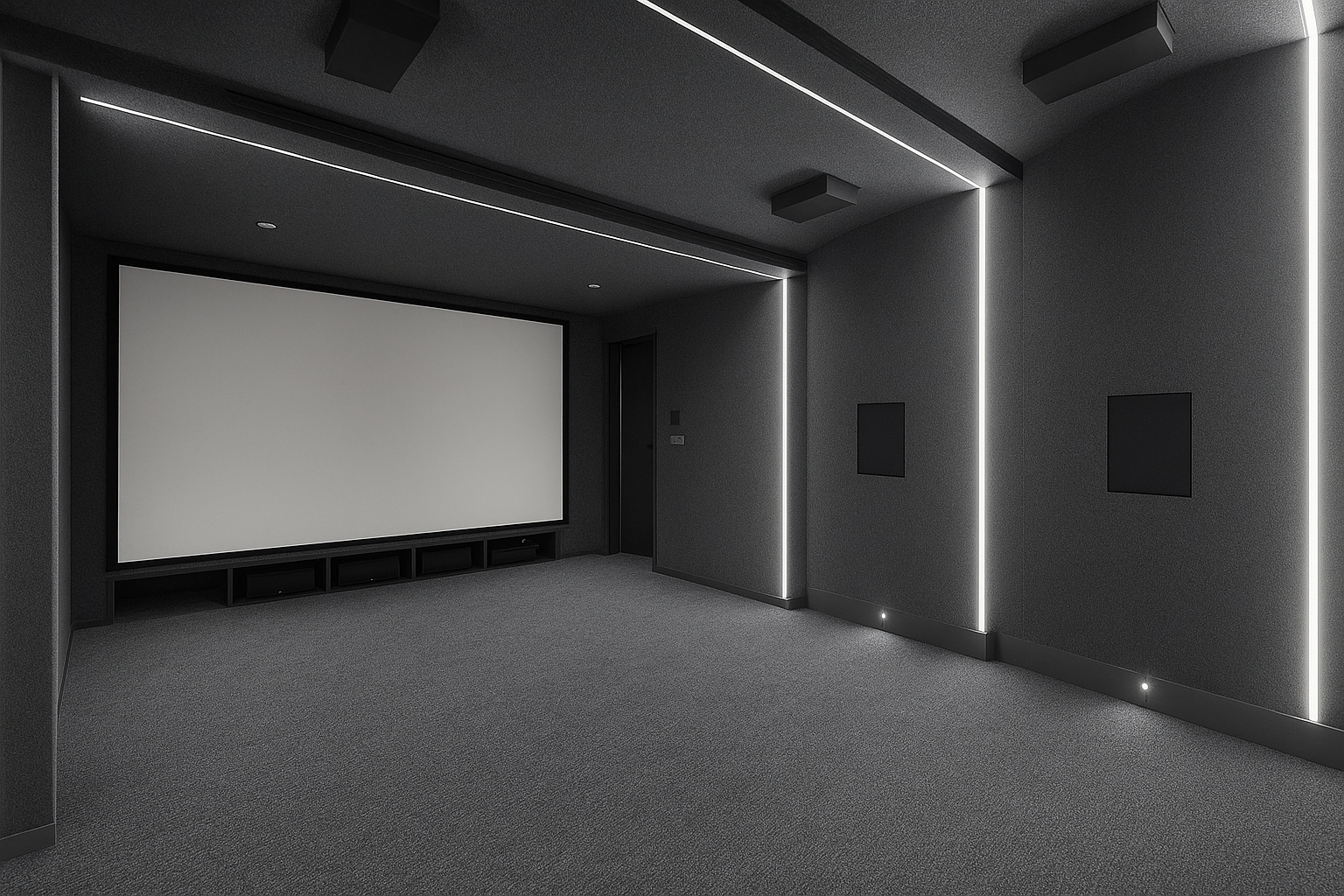
Table of Contents
What “Soundproofing & Acoustic Home Theatre / Home Cinema” Really Means
Soundproofing & Acoustic Home Theatre / Home Cinema covers two tasks: stopping sound from leaking between rooms (soundproofing) and shaping the sound inside the room (acoustic treatment). When you combine both, your home cinema achieves crisp dialogue, impactful bass and a consistent sweet spot across seats.
Soundproofing vs. Acoustic Treatment
Soundproofing (Block Noise)
- Stops sound leakage between rooms.
- Uses dense materials: Mass-Loaded Vinyl (MLV), acoustic doors, seals.
- Great for apartments and late-night viewing.
Acoustic Treatment (Shape Sound)
- Improves clarity inside the room.
- Uses acoustic panels, bass traps, and diffusers.
- Controls reflections, flutter echo, and reverb.
New to NRC? See an accessible primer on the Noise Reduction Coefficient (NRC) and an ASTM-based explanation here.
Why Acoustic Panels Are Essential
Balanced, Natural Audio
Panels reduce harsh highs and ringing mids, delivering a smooth tonal balance across seats.
Less Echo & Reverb
Control first reflections so effects are precise, dialogue is intelligible, and music scores feel lifelike.
For speaker & seating geometry in a Soundproofing & Acoustic Home Theatre / Home Cinema, see Dolby’s official guides for Atmos home theater setups and the detailed 5.1.2 overhead placement PDF here.
Low-Frequency Control
Corner bass traps tighten sub-bass, reducing boomy, uneven response.
Looks that Match Your Room
Choose fabrics and colors that blend with interiors—cinema-grade performance without compromising style.

Smart Placement for Home Cinemas
- Side walls: Place panels at the first reflection points (use a mirror trick from the main seat).
- Rear wall: Add absorption to reduce slap-echo and ringing.
- Ceiling: Use ceiling acoustic panels to control vertical reflections.
- Corners: Fit bass traps from floor to ceiling for tighter low end.
Reference listening-room criteria for a Soundproofing & Acoustic Home Theatre / Home Cinema are detailed in ITU-R BS.1116-3. For deeper theory, browse the Audio Engineering Society Journal and Tutorials.
Recommended Products for Home Theatre
Echoshield Acoustic Panels
High NRC panels designed to absorb reflections and improve speech clarity in your Soundproofing & Acoustic Home Theatre / Home Cinema.
View Echoshield PanelsCeiling Acoustic Panels
Lightweight clouds and rafts to tame vertical reflections above seating.
Shop Ceiling PanelsBass Traps
Essential for smooth, controlled bass and impactful low-frequency effects.
Get Bass TrapsMass-Loaded Vinyl (MLV)
Adds density to walls/doors to block noise transfer without major rebuilds.
Shop MLVFurther Reading & Standards
- Dolby Atmos Speaker Setup Guides — official placement for 5.1.2, 5.1.4, etc.
- Dolby 5.1.2 Overhead Speaker Placement (PDF)
- ITU-R BS.1116-3: Reference Listening Room Requirements (PDF)
- Audio Engineering Society — Journal | AES Tutorials
- Noise Reduction Coefficient (NRC) — overview and ASTM definition explainer
Quick Setup Checklist
- Map first reflection points on side walls and ceiling.
- Cover ~20–30% of surfaces with wall + ceiling panels.
- Add bass traps in all vertical corners.
- Seal doors/outlets; add MLV if you need isolation.
- Calibrate your AVR (room EQ) after installing panels.
FAQs: Soundproofing & Acoustic Home Theatre / Home Cinema
- Do I need both soundproofing and acoustic treatment?
- Yes. For a reliable Soundproofing & Acoustic Home Theatre / Home Cinema outcome, combine isolation products with wall, ceiling and corner treatment.
- How many panels should I start with?
- Begin with 6–10 wall/ceiling panels plus 2–4 corner bass traps for a medium room (~12–18 m²). Add more as your Soundproofing & Acoustic Home Theatre / Home Cinema evolves.
- Will panels make my room look dull?
- No—designer fabrics and framed panels enhance interiors while improving sound in your Soundproofing & Acoustic Home Theatre / Home Cinema.
- Where should I place ceiling panels?
- Above the main seating at first reflection points. This is one of the highest-impact upgrades in any Soundproofing & Acoustic Home Theatre / Home Cinema.
Ready to Upgrade Your Sound?
Build a cinema-grade room with pro-quality panels—installed in hours, not weeks.
Tip: Use this phrase exactly — Soundproofing & Acoustic Home Theatre / Home Cinema — in your Yoast/RankMath focus keyword field.
Soundproofing & Acoustic Home Theatre / Home Cinema: 7 Proven Fixes for Perfect Audio
This guide explains how to plan Soundproofing & Acoustic Home Theatre / Home Cinema setups, from blocking noise to tuning the room for cinematic clarity.

Table of Contents
What “Soundproofing & Acoustic Home Theatre / Home Cinema” Really Means
Soundproofing & Acoustic Home Theatre / Home Cinema covers two tasks: stopping sound from leaking between rooms (soundproofing) and shaping the sound inside the room (acoustic treatment). When you combine both, your home cinema achieves crisp dialogue, impactful bass and a consistent sweet spot across seats.
Soundproofing vs. Acoustic Treatment
Soundproofing (Block Noise)
- Stops sound leakage between rooms.
- Uses dense materials: Mass-Loaded Vinyl (MLV), acoustic doors, seals.
- Great for apartments and late-night viewing.
Acoustic Treatment (Shape Sound)
- Improves clarity inside the room.
- Uses acoustic panels, bass traps, and diffusers.
- Controls reflections, flutter echo, and reverb.
New to NRC? See an accessible primer on the Noise Reduction Coefficient (NRC) and an ASTM-based explanation here.
Why Acoustic Panels Are Essential
Balanced, Natural Audio
Panels reduce harsh highs and ringing mids, delivering a smooth tonal balance across seats.
Less Echo & Reverb
Control first reflections so effects are precise, dialogue is intelligible, and music scores feel lifelike.
For speaker & seating geometry in a Soundproofing & Acoustic Home Theatre / Home Cinema, see Dolby’s official guides for Atmos home theater setups and the detailed 5.1.2 overhead placement PDF here.
Low-Frequency Control
Corner bass traps tighten sub-bass, reducing boomy, uneven response.
Looks that Match Your Room
Choose fabrics and colors that blend with interiors—cinema-grade performance without compromising style.

Smart Placement for Home Cinemas
- Side walls: Place panels at the first reflection points (use a mirror trick from the main seat).
- Rear wall: Add absorption to reduce slap-echo and ringing.
- Ceiling: Use ceiling acoustic panels to control vertical reflections.
- Corners: Fit bass traps from floor to ceiling for tighter low end.
Reference listening-room criteria for a Soundproofing & Acoustic Home Theatre / Home Cinema are detailed in ITU-R BS.1116-3. For deeper theory, browse the Audio Engineering Society Journal and Tutorials.
Recommended Products for Home Theatre
Echoshield Acoustic Panels
High NRC panels designed to absorb reflections and improve speech clarity in your Soundproofing & Acoustic Home Theatre / Home Cinema.
View Echoshield PanelsCeiling Acoustic Panels
Lightweight clouds and rafts to tame vertical reflections above seating.
Shop Ceiling PanelsBass Traps
Essential for smooth, controlled bass and impactful low-frequency effects.
Get Bass TrapsMass-Loaded Vinyl (MLV)
Adds density to walls/doors to block noise transfer without major rebuilds.
Shop MLVFurther Reading & Standards
- Dolby Atmos Speaker Setup Guides — official placement for 5.1.2, 5.1.4, etc.
- Dolby 5.1.2 Overhead Speaker Placement (PDF)
- ITU-R BS.1116-3: Reference Listening Room Requirements (PDF)
- Audio Engineering Society — Journal | AES Tutorials
- Noise Reduction Coefficient (NRC) — overview and ASTM definition explainer
Quick Setup Checklist
- Map first reflection points on side walls and ceiling.
- Cover ~20–30% of surfaces with wall + ceiling panels.
- Add bass traps in all vertical corners.
- Seal doors/outlets; add MLV if you need isolation.
- Calibrate your AVR (room EQ) after installing panels.
FAQs: Soundproofing & Acoustic Home Theatre / Home Cinema
- Do I need both soundproofing and acoustic treatment?
- Yes. For a reliable Soundproofing & Acoustic Home Theatre / Home Cinema outcome, combine isolation products with wall, ceiling and corner treatment.
- How many panels should I start with?
- Begin with 6–10 wall/ceiling panels plus 2–4 corner bass traps for a medium room (~12–18 m²). Add more as your Soundproofing & Acoustic Home Theatre / Home Cinema evolves.
- Will panels make my room look dull?
- No—designer fabrics and framed panels enhance interiors while improving sound in your Soundproofing & Acoustic Home Theatre / Home Cinema.
- Where should I place ceiling panels?
- Above the main seating at first reflection points. This is one of the highest-impact upgrades in any Soundproofing & Acoustic Home Theatre / Home Cinema.
Ready to Upgrade Your Sound?
Build a cinema-grade room with pro-quality panels—installed in hours, not weeks.
Tip: Use this phrase exactly — Soundproofing & Acoustic Home Theatre / Home Cinema — in your Yoast/RankMath focus keyword field.
Soundproofing & Acoustic Home Theatre / Home Cinema: 7 Proven Fixes for Perfect Audio
This guide explains how to plan Soundproofing & Acoustic Home Theatre / Home Cinema setups, from blocking noise to tuning the room for cinematic clarity.

Table of Contents
What “Soundproofing & Acoustic Home Theatre / Home Cinema” Really Means
Soundproofing & Acoustic Home Theatre / Home Cinema covers two tasks: stopping sound from leaking between rooms (soundproofing) and shaping the sound inside the room (acoustic treatment). When you combine both, your home cinema achieves crisp dialogue, impactful bass and a consistent sweet spot across seats.
Soundproofing vs. Acoustic Treatment
Soundproofing (Block Noise)
- Stops sound leakage between rooms.
- Uses dense materials: Mass-Loaded Vinyl (MLV), acoustic doors, seals.
- Great for apartments and late-night viewing.
Acoustic Treatment (Shape Sound)
- Improves clarity inside the room.
- Uses acoustic panels, bass traps, and diffusers.
- Controls reflections, flutter echo, and reverb.
New to NRC? See an accessible primer on the Noise Reduction Coefficient (NRC) and an ASTM-based explanation here.
Why Acoustic Panels Are Essential
Balanced, Natural Audio
Panels reduce harsh highs and ringing mids, delivering a smooth tonal balance across seats.
Less Echo & Reverb
Control first reflections so effects are precise, dialogue is intelligible, and music scores feel lifelike.
For speaker & seating geometry in a Soundproofing & Acoustic Home Theatre / Home Cinema, see Dolby’s official guides for Atmos home theater setups and the detailed 5.1.2 overhead placement PDF here.
Low-Frequency Control
Corner bass traps tighten sub-bass, reducing boomy, uneven response.
Looks that Match Your Room
Choose fabrics and colors that blend with interiors—cinema-grade performance without compromising style.

Smart Placement for Home Cinemas
- Side walls: Place panels at the first reflection points (use a mirror trick from the main seat).
- Rear wall: Add absorption to reduce slap-echo and ringing.
- Ceiling: Use ceiling acoustic panels to control vertical reflections.
- Corners: Fit bass traps from floor to ceiling for tighter low end.
Reference listening-room criteria for a Soundproofing & Acoustic Home Theatre / Home Cinema are detailed in ITU-R BS.1116-3. For deeper theory, browse the Audio Engineering Society Journal and Tutorials.
Recommended Products for Home Theatre
Echoshield Acoustic Panels
High NRC panels designed to absorb reflections and improve speech clarity in your Soundproofing & Acoustic Home Theatre / Home Cinema.
View Echoshield PanelsCeiling Acoustic Panels
Lightweight clouds and rafts to tame vertical reflections above seating.
Shop Ceiling PanelsBass Traps
Essential for smooth, controlled bass and impactful low-frequency effects.
Get Bass TrapsMass-Loaded Vinyl (MLV)
Adds density to walls/doors to block noise transfer without major rebuilds.
Shop MLVFurther Reading & Standards
- Dolby Atmos Speaker Setup Guides — official placement for 5.1.2, 5.1.4, etc.
- Dolby 5.1.2 Overhead Speaker Placement (PDF)
- ITU-R BS.1116-3: Reference Listening Room Requirements (PDF)
- Audio Engineering Society — Journal | AES Tutorials
- Noise Reduction Coefficient (NRC) — overview and ASTM definition explainer
Quick Setup Checklist
- Map first reflection points on side walls and ceiling.
- Cover ~20–30% of surfaces with wall + ceiling panels.
- Add bass traps in all vertical corners.
- Seal doors/outlets; add MLV if you need isolation.
- Calibrate your AVR (room EQ) after installing panels.
FAQs: Soundproofing & Acoustic Home Theatre / Home Cinema
- Do I need both soundproofing and acoustic treatment?
- Yes. For a reliable Soundproofing & Acoustic Home Theatre / Home Cinema outcome, combine isolation products with wall, ceiling and corner treatment.
- How many panels should I start with?
- Begin with 6–10 wall/ceiling panels plus 2–4 corner bass traps for a medium room (~12–18 m²). Add more as your Soundproofing & Acoustic Home Theatre / Home Cinema evolves.
- Will panels make my room look dull?
- No—designer fabrics and framed panels enhance interiors while improving sound in your Soundproofing & Acoustic Home Theatre / Home Cinema.
- Where should I place ceiling panels?
- Above the main seating at first reflection points. This is one of the highest-impact upgrades in any Soundproofing & Acoustic Home Theatre / Home Cinema.
Ready to Upgrade Your Sound?
Build a cinema-grade room with pro-quality panels—installed in hours, not weeks.
Tip: Use this phrase exactly — Soundproofing & Acoustic Home Theatre / Home Cinema — in your Yoast/RankMath focus keyword field.
